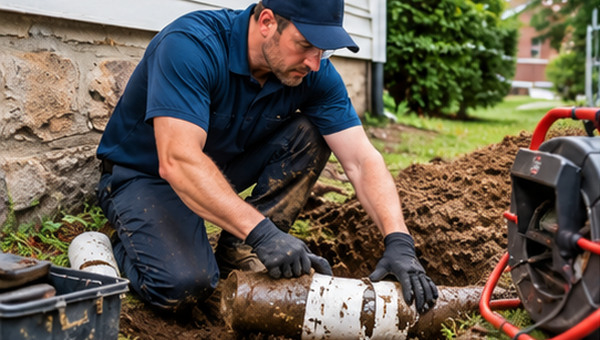
Sewer Line Repair in Ashburn, VA:
Solutions for Damaged Sewer Pipes
When wastewater backs up, multiple drains stop
working, or unpleasant sewer odors appear around
your Ashburn property, the problem may involve
your main sewer line. Tree-root intrusion,
cracked pipes, shifting soil, and recurring
blockages can all affect underground drainage.
Ashburn Plumbing Repair helps homeowners and
businesses explore appropriate sewer line
inspection and repair solutions before
problems become more disruptive.
Sewer line repair in Ashburn, VA focuses on addressing
damage to the underground pipes that carry wastewater
away from homes and commercial properties toward the
public sewer system or an on-site wastewater system.
Sewer pipes can develop problems from tree-root
intrusion, shifting soil, cracked or broken sections,
deteriorating pipe materials, and misaligned joints
that restrict proper drainage. Common warning signs
include recurring sewage backups, multiple slow drains,
gurgling plumbing fixtures, unpleasant sewer odors,
and unusually wet areas around a property. Depending
on the location and extent of the damage, an appropriate
solution may involve a targeted sewer pipe repair,
replacement of a damaged section, or evaluation of
other available sewer line restoration methods.
For homeowners in Ashburn Village, Broadlands,
Brambleton, and surrounding Ashburn communities,
understanding the cause of a sewer line problem
is essential before choosing a repair approach.
Ashburn Plumbing Repair focuses on helping property
owners understand potential sewer line issues,
available repair options, and practical next steps
toward restoring dependable wastewater drainage.
SIGNS YOU NEED US
Signs You Need Sewer Line Repair
Several fixtures drain poorly:
When toilets, sinks, and showers develop
drainage trouble at the same time,
the obstruction may be beyond an
individual fixture.
Wastewater appears in lower-level drains:
Sewage rising through a basement floor drain
or shower when another fixture is used
can indicate a restriction in the main line.
Toilets make unusual bubbling sounds:
Gurgling or fluctuating water levels
during nearby plumbing use may suggest
a drainage or venting problem
that needs investigation.
One part of the yard stays unusually wet:
Persistent damp soil, a sunken patch,
or unexpected ground movement near
the sewer route may warrant checking
for an underground leak.
Blockages return soon after clearing:
Frequent main-line stoppages may be
associated with a pipe defect,
accumulated deposits, or an
obstruction that was not fully resolved.
Persistent sewage smells:
Odors near a sewer cleanout, basement,
or outdoor drainage area may point
to an issue requiring closer examination,
especially alongside other warning signs.
Four clear stages to help you understand
how underground sewer problems are assessed
and addressed.
01
Discuss Your Sewer Problem
Tell us when the issue started, which
plumbing fixtures are affected, and
whether wastewater has entered the
property. These details help establish
the urgency and prepare for an
appropriate assessment.
02
Locate the Affected Pipe Section
The sewer route, accessible cleanouts,
and relevant plumbing connections
are reviewed. Where appropriate,
additional diagnostic methods may
help determine the location and
extent of the suspected defect.
03
Plan and Complete the Repair
The proposed work depends on pipe
material, depth, accessibility, and
damage severity. A suitable approach
may involve a localized pipe correction,
replacement of a failed section,
or another feasible repair method.
04
Verify Results and Review Next Steps
Once the agreed work is finished,
appropriate checks help evaluate
wastewater flow and the repaired
connection. The findings, any
remaining concerns, and useful
maintenance guidance are then reviewed.
WHAT YOU GAIN
What You Get
A Repair Approach That Fits the Actual Damage
Addressing the affected portion of a sewer pipe,
when feasible, can help avoid unnecessary work
elsewhere along the drainage system.
More Dependable Wastewater Drainage
Correcting a failed sewer connection or damaged
pipe section helps restore the route wastewater
needs to leave your property.
Better Planning for Your Yard and Landscaping
Knowing where work may be required allows you
to prepare for access, protect nearby features,
and discuss restoration needs in advance.
Lower Risk of Disruptive Indoor Sewage Damage
Addressing sewer defects before conditions
worsen may reduce the likelihood of wastewater
reaching finished basements, flooring,
and stored belongings.
Greater Confidence in Your Property's Plumbing
A functioning underground sewer connection
supports everyday household use and can help
reduce uncertainty about future drainage trouble.
Useful Information for Future Maintenance
Understanding the condition of the repaired
area helps you make informed decisions about
monitoring, routine care, and possible
follow-up inspections.
SEWER REPAIR SOLUTIONS
Our Sewer Line Repair Services in Ashburn, VA
Underground wastewater systems can develop different
structural and drainage problems. Explore the sewer
repair needs and possible solutions relevant to
residential and commercial properties in Ashburn,
Virginia. The appropriate method depends on an
assessment of the pipe and site conditions.
01
Damaged Sewer Pipe Repairs
Addressing physical defects that interfere with
the performance of underground wastewater lines.
Cracked Sewer Pipe Repair
Fractures in underground piping can allow
wastewater to escape and surrounding soil
to enter. Repair planning considers the
crack's location, pipe material, and whether
the affected section remains structurally sound.
Broken Sewer Line Repair
A separated or fractured drain segment may
interrupt wastewater transport. Depending
on accessibility and surrounding conditions,
the damaged portion may require removal,
reconnection, or replacement.
Collapsed Sewer Line Solutions
Severe deterioration or external pressure
can cause a pipe to lose its shape.
Because a collapsed section cannot
reliably carry waste, structural repair
or replacement may be necessary.
Offset Sewer Joint Repair
Ground movement can shift adjoining
pipe sections out of alignment.
An offset joint may catch debris
and restrict flow. Corrective work
focuses on the displaced connection
and its surrounding pipe condition.
Sagging Sewer Pipe Correction
A low section, sometimes called a sewer
belly, can retain water and solids.
Where the pipe's slope is inadequate,
restoring proper alignment may involve
excavation and rebuilding the affected run.
02
Underground Sewer Line Restoration
Exploring methods for deteriorated pipes,
damaged laterals, and difficult-to-access lines.
Tree Root-Damaged Sewer Pipes
Roots can enter through openings in
underground pipe joints and expand
existing defects. Long-term correction
may require addressing the entry point,
not simply cutting away the growth.
Traditional Excavation Repair
Open-trench work provides direct access
when a sewer section must be exposed.
This method may be appropriate for
severely damaged piping, alignment
corrections, or conditions that limit
less-invasive alternatives.
Trenchless Sewer Repair Options
Some pipe defects may qualify for
rehabilitation techniques that reduce
continuous trench excavation. Suitability
depends on pipe geometry, structural
condition, access points, and the
technology available for the project.
Sewer Line Replacement
Replacement may be considered when
deterioration extends across multiple
sections or the existing material
cannot be repaired effectively.
Pipe sizing, route, depth, and
applicable requirements influence planning.
Residential Sewer Lateral Repair
The lateral carries wastewater from
a building toward the receiving sewer.
Defects in this connection may affect
multiple household fixtures.
Repair scope also depends on local
utility boundaries and ownership rules.
03
Diagnosis, Backups & Property-Specific Needs
Understanding complex sewer issues before
choosing a long-term corrective approach.
Sewer Camera Inspection
Where access and conditions permit,
camera equipment can help identify
internal defects, obstructions, and
connection problems. Visual findings
may assist with repair planning,
although some issues require further testing.
Sewage Backup Investigation
A backup can originate from a private
lateral, shared drainage connection,
or public sewer issue. Determining
the likely source is important before
authorizing work on underground piping.
Underground Sewer Leak Assessment
Hidden wastewater leaks may affect
soil conditions and nearby structures.
Evaluation can involve examining
accessible piping, drainage behavior,
and site evidence to narrow down
the suspected leak location.
Commercial Sewer Line Repair
Offices, retail premises, and other
commercial buildings may have larger
drainage demands and different access
constraints. Repair planning should
account for business operations,
fixture usage, and applicable codes.
Urgent Sewer Line Repair Concerns
Active sewage overflow, contaminated
standing water, or a sudden loss of
drainage calls for prompt attention.
Avoid using affected fixtures and
keep people away from wastewater
while arranging professional assistance.
Not sure which repair is appropriate?
Sewer line conditions vary from property to property.
Call 0000 to discuss your
situation in Ashburn, VA. Specialized equipment
and repair methods are subject to availability
and site suitability.
Serving Ashburn, Virginia
•
Sewer Pipe Repair Inquiries
•
Discuss Your Next Steps
GOOD QUESTIONS
Questions About Sewer Line Repair
Have another question about your sewer system?
Call 0000 to discuss
your property in Ashburn, VA.
How do plumbers locate a broken underground sewer pipe?
Plumbers may examine accessible cleanouts,
evaluate drainage patterns, and use sewer
inspection cameras to view the pipe interior.
Some camera systems include locating equipment
that helps estimate the position of a defect
from above ground. The diagnostic method
depends on access and pipe conditions.
Will sewer line repair require digging up my entire yard?
Not necessarily. A localized defect may be
accessible through a smaller excavation.
Other situations require a longer trench
or specialized rehabilitation methods.
Pipe depth, damage location, landscaping,
and nearby utilities all influence
the amount of excavation needed.
How long does sewer line repair take in Ashburn, VA?
The timeline depends on the length of pipe
involved, soil conditions, excavation access,
required permits, and inspection arrangements.
A straightforward spot repair may be completed
faster than a full lateral replacement.
A realistic schedule can be discussed once
the proposed work is established.
Can a sewer line be repaired without digging?
Some sewer pipes qualify for trenchless
techniques such as lining or pipe bursting.
These methods may reduce excavation but
are not suitable for every condition.
Severely collapsed pipes, significant
alignment defects, and limited access
can restrict the available options.
How much does sewer line repair cost in Ashburn?
Pricing varies with pipe depth, length,
material, access, repair method, and
surface restoration requirements.
Excavation beneath a driveway may
involve different costs from work
in an open lawn. An assessment and
defined scope are needed for a
meaningful estimate.
Who is responsible for repairing the sewer line between my house and the street?
Responsibility depends on local utility
rules, property boundaries, and the
location of the affected pipe.
Homeowners are often responsible for
some or all of their private sewer
lateral, but the exact division varies.
Confirm the requirements with the
relevant sewer authority before
authorizing work.
Does homeowners insurance cover sewer pipe repairs?
Standard homeowners policies may exclude
damage caused by gradual deterioration,
wear, or certain underground pipe failures.
Optional service-line coverage or other
endorsements may provide protection
under specified circumstances.
Review your policy and contact your
insurer for coverage details.
Can I continue using toilets and sinks during sewer line repair?
Water use may need to be restricted
when the main sewer connection is
blocked, disconnected, or undergoing
repair. Continuing to discharge
wastewater can create backups
or interfere with the work.
Follow the instructions provided
for your particular repair.
Are permits required for sewer line replacement in Ashburn, Virginia?
Permits, utility coordination, and
inspections may be required depending
on the work and its location.
Properties in Ashburn can be subject
to Loudoun County requirements and
the applicable wastewater utility's
procedures. Confirm current rules
before excavation or replacement begins.
What should I do if sewage is backing up into my basement?
Stop using fixtures connected to
the affected drainage system.
Keep children and pets away from
contaminated water, avoid contact
with sewage, and do not enter
flooded areas where electrical
hazards may be present. Arrange
professional plumbing assistance
and appropriate cleanup.
Need Sewer Line Repair in Ashburn, VA?
Get guidance on your sewer problem and
explore the right next step for your property.